MIL-A-8625 Anodizing Services for Corrosion
When aluminum components need to meet the highest levels of durability and performance, manufacturers and OEMs often turn to MIL-A-8625 anodizing services. This military specification has become the gold standard for anodic coatings in both aerospace and defense applications, outlining strict requirements for six types and two classes of anodized finishes.
By adhering to MIL-A-8625, anodizers ensure that parts achieve the corrosion resistance, paint adhesion, and abrasion resistance required in mission-critical environments. Whether the project calls for conventional sulfuric acid anodizing, thin-film alternatives, or hardcoat finishes, this specification guarantees consistency, reliability, and proven performance.
How PFI Delivers Precision MIL-A-8625 Anodizing Services
At Progress for Industry (PFI), we provide MIL-A-8625 anodizing services that cover the most widely used coating types, including Type II sulfuric acid anodizing, Type IIB thin sulfuric acid anodizing as a non-chromate alternative, and Type III hard anodic coatings.
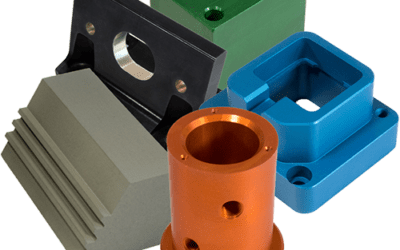
These finishes can be tailored for specific applications: For example, Type II finishes can be dyed in a variety of colors for specific applications. Type III produces an exceptionally hard, wear-resistant, and non-conductive layer with added thickness, making it ideal for parts exposed to extreme conditions, heat, or marine environments.
Our anodizing experts work directly with customers to determine the most cost-effective thickness and finish. This ensures compliance with MIL-A-8625 standards while optimizing each part for its end use.
Architectural Spec AAMA 611-98 vs MIlitary Spec Mil-A-8625
The specifications can overlap, particularly with Mil-A-8625 Type II. While it shares similarities with AAMA 611-98, key differences exist between them. The primary distinction lies in their applications: AAMA 611-98 (American Architectural Manufacturers Association) serves architectural purposes, while Mil-A-8625 addresses non-architectural needs.
Both specs have class I and class II finish options, but they are not to be confused with one another, as they both mean different things. For AAMA 611-98, class I is a high-performance finish mainly used for exterior applications. Class II is an anodic coating used for more imposing commercial applications.
Mil-A-8625 is much simpler; class I refers to non-dyed coatings, and class II means the coating is dyed/colored after anodizing and before sealing. Another main difference between these two specifications is that the AAMA also calls out quality tests that a customer may or may not want performed by the anodizer or a third-party lab. PFI generally offers options for blue, red, yellow, green, and black coloring, though other colors may be available by request.
Please note that PFI does not use the AAMA 611-98 specification, but anodizes using Mil-A-8625, which is extremely similar. Please contact us with specific questions in regards to these specs.
PFI Inc: The Industry Expert on Anodizing and other Plating Services
General manager Gene Bianco is keen on making sure there is a procedure in place for every anodizing process available at PFI. For over 30 years, Progress for Industry, Inc. has created excellent metal finishing services for the molding industry. Many of PFI’s workers have been there since its establishment in 1982.
Our team excels in maintaining dimensional excellence even in intricate designs when providing any anodizing service, from thick protective layers to light layers for daily use. Our team’s expertise ensures precise anodizing and dimensional excellence for every project.